

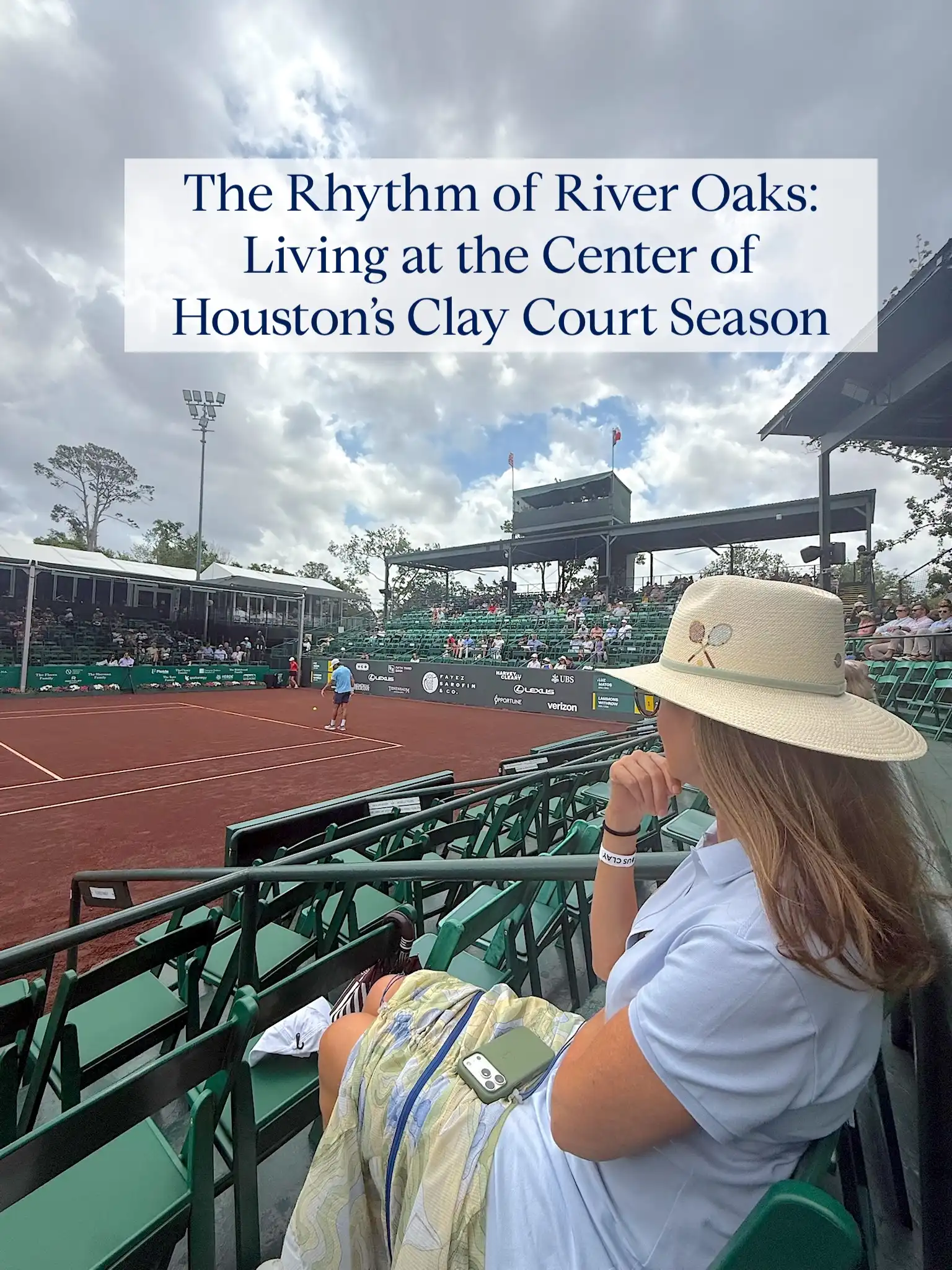
River Oaks has always carried a legacy, both as a neighborhood and an idea. Developed in the
1920s, the Hogg brothers and Hugh Potter designed it intentionally with a landscape and lifestyle
that worked together rather than competing for attention. Today, this original structure and sense
of continuity are largely preserved in the same way. Now, the neighborhood’s history isn’t what
keeps River Oaks thriving; rather, it’s how River Oaks has continued to embrace its original
intent.
On a spring afternoon, you can trace the rhythm of the neighborhood through the people moving
in and out of it. There’s a steady flow of people toward the River Oaks Country Club, where
generations have gathered not just for tennis, but for something more social, more cultural. Since
1931, it has hosted what is now known as the U.S. Men’s Clay Court Championship. This event
has become a symbolic anchor for the neighborhood’s identity. The matches aren’t the sole
reason that River Oaks is significant, but being near something that matters adds to the prestige.
During tournament season, the neighborhood takes on a distinct rhythm as people move through
the streets with a sense of occasion. You notice the subtle intention in how people show up, and
even outside the gates, the tournament becomes part of daily life by shaping the mood of the
area. This proximity is part of what defines River Oaks, where location means more than
geography and instead offers a connection to moments as they unfold in real time. At the same
time, the neighborhood holds onto a sense of balance that keeps it grounded.
Step a few blocks away and everything softens again. The streets are calm, residential in the
purest sense of the word. Most homes, new or old, sit back on lots that invite you to take it all in,
framed by landscaping that feels almost architectural. It’s easy to call it luxurious, and it is, but
the word doesn’t fully capture why.
Luxury here isn’t simply about scale or price, though both are undeniably part of the story.
Homes in the area range from around $1.5 million to well over $20 million, with steady demand
and long-term value growth, reinforcing the neighborhood’s appeal. Yet, what stands out most
and what is the most distinct factor about River Oaks is how livable it feels. There’s a sense of
ease woven into everything, from the walkability to the way neighbors interact.
People describe it as prestigious, sometimes even calling it the “Beverly Hills of Houston,” but
that comparison only goes so far. What River Oaks does differently is that it doesn’t feel
performative; rather, it feels established. You see it in the details—the quiet continuity of the
streets. The way old homes are preserved instead of being replaced. The mix of long-time
residents and newer families who are drawn in not just by the real estate, but by what it
represents.
Then, there’s everything just beyond it. Within minutes, you’re at some of Houston’s best dining,
shopping, and cultural institutions. The neighborhood sits almost at the center of it all, yet
manages to feel removed in the best way. That contrast is part of its appeal. You can step into the
city when you want to, and step away just as easily.
During tournament season, River Oaks Country Club draws a steady flow of people, and that
energy spills out onto the surrounding streets, shaping the day’s pace without overwhelming it.
You notice it in the quiet sense of anticipation and in how the area feels just a little more alive
than usual. Living nearby means you experience that atmosphere in real time, without having to
plan for it, which is what gives the location its real appeal. The neighborhood still holds onto its
sense of calm, and that contrast is part of what makes it work so well.
It’s not just where you live, it’s where everything already happens.
Until next time,
Dee Dee Guggenheim Howes
Source:
https://www.mansionglobal.com/articles/the-beverly-hills-of-houston-is-thriving-144d6980