

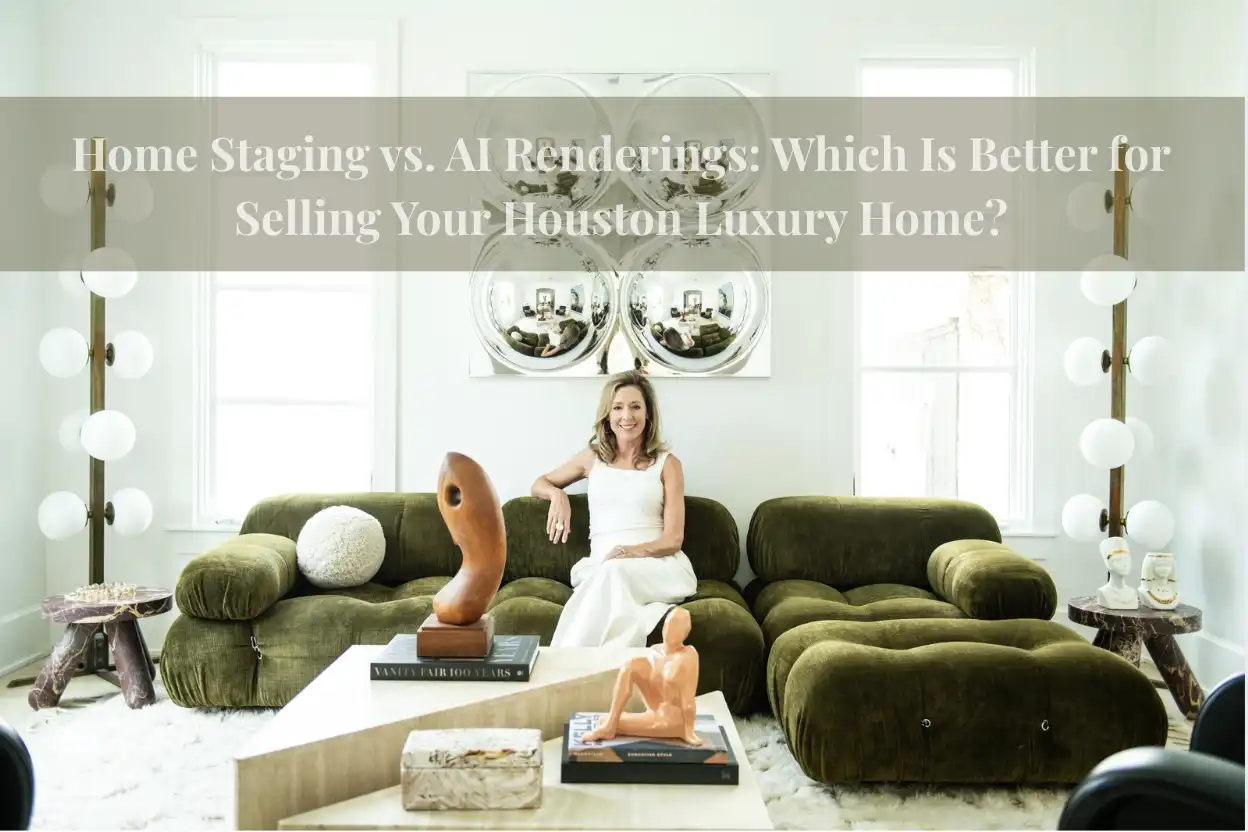
For years, professional staging has been one of the most effective ways to prepare a luxury home for sale. A beautifully staged home helps buyers envision how each room lives, highlights architectural details and creates the emotional connection that often leads to stronger offers.
Today, however, sellers have another option. Artificial intelligence can digitally furnish empty rooms, update finishes and even reimagine an entire space without moving a single piece of furniture.
Both strategies have their place, but they are not interchangeable. Understanding when to stage, when to use AI renderings and when to combine both can make a meaningful difference in how your home is perceived online and in person.
As I prepare luxury homes throughout Houston, I look at each property individually because the best marketing plan depends on the home’s architecture, condition and target buyer.
Why Presentation Matters More Than Ever
For most luxury buyers, the first showing happens online. Professional photography has become the first open house, and buyers often decide whether to schedule a private tour after only a few seconds of scrolling through listing photos. That means presentation is no longer just part of the selling process. It is often what determines whether a buyer takes the next step.
Whether a home is located in Tanglewood, Memorial, West University or River Oaks, buyers expect listings to feel polished, intentional and move-in ready. The question is not whether presentation matters. It is which strategy tells your home’s story most effectively.
Professional staging remains the gold standard for occupied or move-in-ready luxury homes because it creates an experience that buyers can both see and feel. Rather than simply decorating, a professional stager carefully arranges furnishings to showcase scale, improve flow and emphasize the home’s architecture. The goal is to help buyers appreciate the home itself instead of focusing on the current owner’s personal style.
Luxury purchases are often emotional decisions. Buyers may not remember every measurement or finish after touring several homes, but they usually remember how a home made them feel. A thoughtfully staged living room, an inviting primary suite or a beautifully styled outdoor entertaining space creates an emotional connection that often lingers long after the showing ends.
Staging also helps showcase many of the architectural details that make Houston luxury homes so distinctive. Whether it is soaring ceilings, custom millwork, dramatic staircases, expansive windows or seamless indoor-outdoor living spaces, carefully selected furnishings draw attention to these features instead of competing with them. At the same time, staging gives buyers a better understanding of how each room functions. Open-concept layouts, oversized rooms and flexible spaces can sometimes feel difficult to interpret when they are empty, but thoughtful furniture placement provides scale and context that allows buyers to immediately envision everyday living.
Professional staging also elevates photography. Empty rooms often appear smaller than they are, while overcrowded rooms can feel distracting. Well-staged spaces photograph beautifully, helping your listing make a stronger first impression both online and in print marketing.
Where AI Renderings Fit Into Luxury Marketing
While staging remains incredibly valuable, AI renderings have quickly become another useful tool in luxury real estate marketing. Rather than physically furnishing a property, AI technology digitally transforms listing photos by adding furniture, modernizing finishes or illustrating renovation possibilities.
When used thoughtfully, AI renderings answer many of the questions buyers naturally ask while scrolling through listings. What would this room look like furnished? How much brighter could this kitchen feel with lighter cabinetry? Could this bonus room become a home office, media room or gym? Instead of asking buyers to imagine the possibilities on their own, AI provides visual inspiration that helps them see a home’s potential.
Digital renderings are especially effective for vacant luxury homes, where large empty spaces can sometimes feel cold or difficult to understand in photographs. They also work well for new construction, allowing builders and buyers to visualize finished interiors before construction is complete. Likewise, AI can help sellers showcase renovation opportunities by illustrating how an older kitchen, dated bathroom or underutilized living area could be transformed without requiring the seller to complete those renovations before listing.
That said, AI works best as a visualization tool rather than a replacement for reality. Buyers should always understand what they are seeing, and digitally enhanced images should accurately reflect the home’s potential rather than create unrealistic expectations.
The Best Marketing Strategy Often Uses Both
Although AI technology has advanced rapidly, it still cannot replace the experience of walking through a beautifully staged home. Buyers notice details that photographs simply cannot capture. They experience how natural light fills a room, how furniture defines each space and how the home’s overall scale feels in person. For occupied luxury homes or properties expected to receive significant private showings, professional staging typically delivers the strongest return because it enhances both the online presentation and the in-person experience.
At the same time, this is not necessarily an either-or decision. Some of the most effective luxury marketing strategies combine both approaches. A seller might professionally stage the home’s primary living areas while using AI renderings to illustrate the possibilities for an unfinished bonus room, a home office or a vacant guest suite. Others may use AI to demonstrate tasteful renovation ideas while allowing buyers to experience the home’s most important spaces exactly as they will see them during a showing.
Technology will continue to evolve, but successful luxury marketing has never been about using the newest tool simply because it exists. It has always been about understanding the home, identifying the most likely buyer and presenting the property in the most compelling way possible.
Every home deserves a customized strategy. A newly built contemporary home in Memorial may require a different presentation than a traditional estate in Tanglewood or a historic residence near Southampton. Before recommending staging, AI renderings or a combination of both, I always consider who the ideal buyer is, what makes the property unique and which marketing approach will best communicate its value. Those answers shape a strategy designed specifically for that home rather than relying on a one-size-fits-all solution.
Finding the Right Approach for Your Home
Professional staging and AI renderings each play an important role in today’s luxury real estate market. Staging creates the emotional, in-person experience that helps buyers connect with a home, while AI renderings offer flexibility by helping buyers visualize possibilities before they ever schedule a showing. The strongest results often come from understanding when each tool should be used and how they can complement one another.
Every luxury home tells a different story, and presenting that story thoughtfully is one of the most important parts of achieving a successful sale.
If you’re considering selling your Houston home, I’d be happy to help you determine whether professional staging, AI renderings or a combination of both makes the most sense for your property. Every home deserves a tailored marketing strategy that highlights its strengths, attracts qualified buyers and reflects today’s luxury market. I’d love to share what I’ve seen work across Houston’s most sought-after neighborhoods and help you prepare your home for a successful sale.
Until next time,
Dee Dee Guggenheim Howes